# The Book is on Amazon.com.fr.co.uk.co.jp.de.es.it etc.

I don’t mean to advertize for amazon, if you find the book in local bookstores, that is great news! Simply, if you are looking to purchase the book as several people ask me, that might be an easy way to do so:

# The Lund Lecture’s video is online

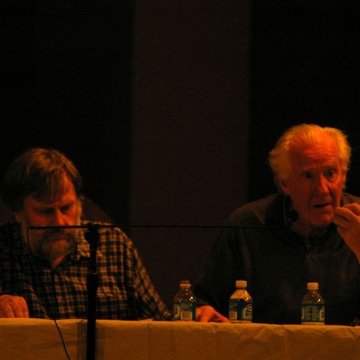
Léopold Lambert Lecture at Lund Architecture Symposium 2012 from Lund School of Architecture on Vimeo.

(Clumsy) presentation of the book at the Lund Architecture Symposium on September 14th 2012.  The lecture is organized in three parts and an appendix:

- Part 1: Lines, Law and Architecture
- Part 2: Palestine
- Part 3: A Disobedient Architecture
- Appendix: Designing, Writing, Editing

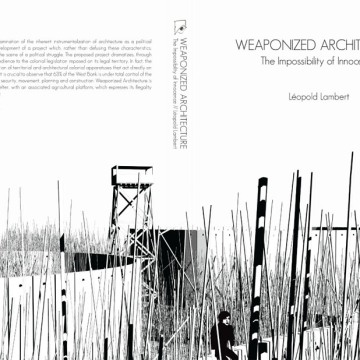
# WEAPONIZED ARCHITECTURE will be published by DPR-Barcelona

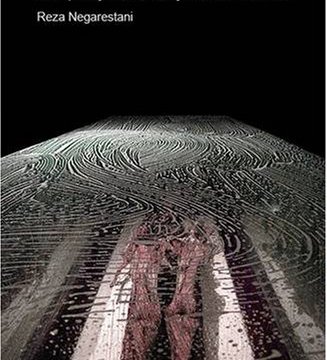
The book Weaponized Architecture: The Impossibility of Innocence that gathers 200 pages of my research and my architectural project will be published in March by DPR-Barcelona.
Ethel Baraona-Pohl and Cesar Reyes were in fact kind enough to take the risk of this publication and we are currently working on it together.

Here is the index of the book:

INTRODUCTION: VIOLENCE ON THE BODY

ARCHITECTURE IS A WEAPON
- Chapter 1: Military Architecture
- Chapter 2: State of Exception
- Chapter 3: Urbicide
- Chapter 4: Architecture of Safety
- Chapter 5: Capitalism’s Architecture
- Chapter 6: Resistive Architectures
- Chapter 7: Smoothing and Striating Space
- Interview: Bryan Finoki

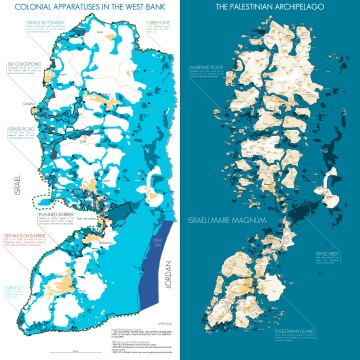
ISRAELI COLONIAL APPARATUSES
- Introduction
- Chapter 1: Israeli Separation Barrier
- Chapter 2: I.D.F.’s Road Checkpoints
- Chapter 3: Israeli Civil Settlements
- Chapter 4: Segregated Infrastructures
- Chapter 5: Areas of Control
- Chapter 6: Militarized Destructions
- Chapter 7: Extreme Urban Example: Hebron
- Interview: Raja Shehadeh

AN ARCHITECTURAL DISOBEDIANCE
- Introduction
- Designed Project

CONCLUSION: SYMPATHY WITH THE OBSTACLE

BIBLIOGRAPHY

ACKNOWLEDGEMENTS

APPENDIX /// LOST IN THE LINE
- Introduction
- Graphic Novel

Claude Parent & Paul Virilio: The Oblique Function (chapter Sympathy with the Obstacle)

Sarajevo after the war in 1995

Paris during the 1848 Revolution

East Jerusalem

Israeli settlement in the West Bank

Hebron (West Bank)

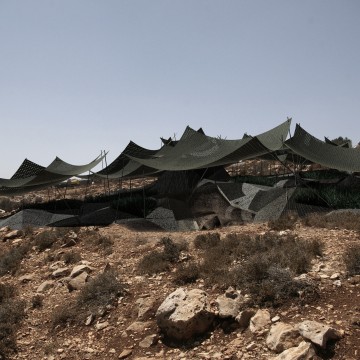
An Architectural Disobediance: Palestinian Qasr and Caravansery in Area C

An Architectural Disobediance: Palestinian Qasr and Caravansery in Area C

An Architectural Disobediance: Palestinian Qasr and Caravansery in Area C

Lost in the Line, an architectural graphic novel

# FINAL PRESENTATION /// Wednesday 8th December

Weaponized Architecture is an examination of the inherent instrumentalization of architecture as a political weapon; research informs the development of a project which, rather than defusing these characteristics, attempts to integrate them within the scene of a political struggle. The proposed project dramatizes, through its architecture, a Palestinian disobedience to the colonial legislation imposed on its legal territory. In fact, the State of Israel masters the elaboration of territorial and architectural colonial apparatuses that act directly on Palestinian daily lives. In this regard, it is crucial to observe that 63% of the West Bank is under total control of the Israeli Defense Forces in regards to security, movement, planning and construction. Weaponized Architecture is thus manifested as a Palestinian shelter, with an associated agricultural platform, which expresses its illegality through its architectural vocabulary.The shelter constitutes both an architectural design and a narrative whose uncertainty is integrated as a creative catalyst.

# Thesis digest

Weaponized Architecture is an examination of the inherent instrumentalization of architecture as a political weapon; research informs the development of a project which, rather than defusing these characteristics, attempts to integrate them within the scene of a political struggle. The proposed project dramatizes, through its architecture, a Palestinian disobedience to the colonial legislation imposed on its legal territory. In fact, the State of Israel masters the elaboration of territorial and architectural colonial apparatuses that act directly on Palestinian daily lives. In this regard, it is crucial to observe that 63% of the West Bank is under total control of the Israeli Defense Forces in regards to security, movement, planning and construction. Weaponized Architecture is thus manifested as a Palestinian shelter, with an associated agricultural platform, which expresses its illegality through its architectural vocabulary.The shelter constitutes both an architectural design and a narrative whose uncertainty is integrated as a creative catalyst.

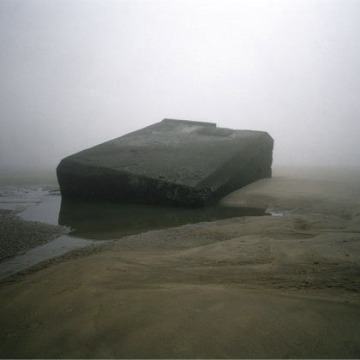
# REFERENCE /// Shotcrete is the way to go

http://en.wikipedia.org/wiki/Shotcrete

# In Progress /// Where am I going ?


Having talked for a while by skype today with my best friend, things appears much clearer to me now. The project is going to change radically and I am taking advantage of the blog here to try to write down my thoughts…

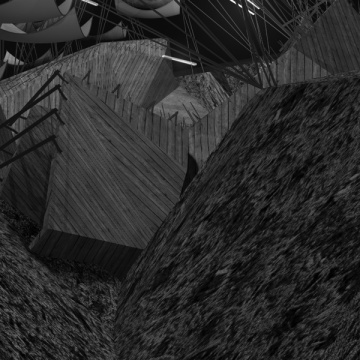
Things already changed a bit when I decided to adopt a cave/tunnel vocabulary to the interface between the 200 yards tunnel between Area A and Area C and the project itself. The result is what can be seen above…a sort of cave (linked to the tunnel) hosting the functions of shelter, sheepfold and agricultural storage (plan to come).

A remark done by my friend was that those posts were really harmful to the legibility of the project (and obviously not in the good camouflage meaning of it) so I should go back to set of bigger tents which needs less posts.

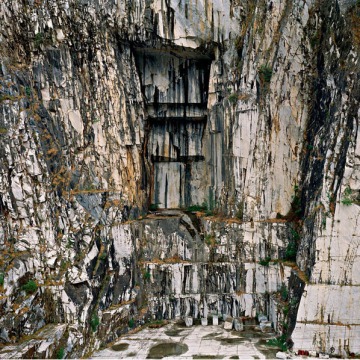
But the changes are going to be more radical as the space should really reflect the tool it has been operated with (I guess it relates back to Aristotle/Deleuze’s notion of Hylomorphism, doesn’t it Jason ?), so the project might use a double language of cave and quarries as seen below (photographs by Edward Burtynsky).

There is also something that I want to work on which is a kind of beauty of a bad crafting…What I mean by that is that there is an urgency involved in this project which forbids the ability to make perfect and beautiful finishes, so the ugliness and imprecision of the result should be enhanced and considered as an opportunity rather than a disappointment. In the cave, for example I am going to consider the surface carved by workers as a given and locally set instructions for locally projecting concrete in order to make a trough or a table (for example) possible. The confusion between concrete and earth (but also probably bad reinforcement wood and electrical sheathing) should bring an interesting and poetical aesthetics I believe…

I understand that it remains only something like one week or so to bring some dramatic changes in the design before starting to really engage the production of representative documents but I think that I can make it…